
Choosing between a DSCR vs conventional loan comes down to how you qualify and what your bigger picture looks like as an investor. Both can finance a rental property, but they take completely different roads to approval, and the right one depends on your income, how many properties you own, and how you want to hold the property. This comparison lays out the real differences so you can decide with confidence.

For the full mechanics of DSCR loans, see our DSCR loans in California guide. Here, we're focused on the head-to-head decision.
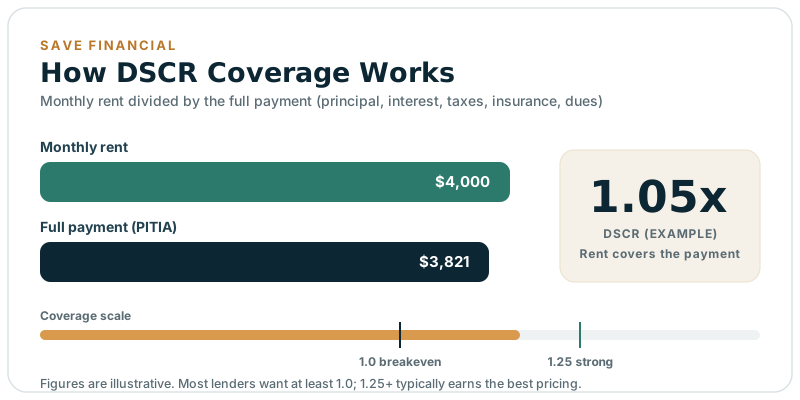
Everything flows from one distinction. A conventional loan qualifies you on your personal income. The lender verifies your tax returns, pay stubs, and employment, and counts the new mortgage in your debt-to-income ratio. A DSCR loan qualifies on the property's income instead, dividing the rent by the payment to get the debt service coverage ratio, and it generally ignores your personal income entirely. That single difference drives everything else, including who each loan suits, how fast it closes, and how it's priced.
| DSCR loan | Conventional loan | |
|---|---|---|
| Qualifies on | Property's rental income | Your personal income |
| Income documents | None (rent and assets only) | Full (tax returns, pay stubs) |
| Personal DTI | Not used | Counts the new payment |
| Down payment | Typically 20 to 25% | Typically 15 to 25% for investment |
| Rate | Usually a bit higher | Usually lower |
| Financed-property limit | Generally none | Capped (often around 10) |
| LLC vesting | Commonly allowed | Usually personal name |
| Prepayment penalty | Often | Typically none |
| Best for | Self-employed, portfolio, LLC buyers | W-2 investors with strong income |
The table is the short version. The sections below explain where each loan actually wins.
This is the heart of it. If your tax returns show strong income and your debt-to-income ratio has room, a conventional loan is straightforward, and lenders can even count a portion of the expected rent to help you qualify. But if you're self-employed and write off heavily, or your DTI is already stretched by other properties or debts, conventional qualifying gets hard fast. A DSCR loan sidesteps all of that by looking only at whether the rent covers the payment. For investors whose personal income is complex or whose DTI is tight, that's the difference between a no and a yes.
Debt-to-income is where conventional financing quietly limits investors, and where DSCR sets you free. On a conventional loan, the new mortgage payment counts in your personal DTI, and while lenders can offset it with a portion of the expected rent, each property you finance still adds to the debt side of your ratio. Buy a few rentals conventionally and your DTI fills up, making the next purchase harder even if every property cash-flows. A DSCR loan doesn't touch your personal DTI at all, because it qualifies on the property. For an investor who plans to keep buying, that distinction compounds: conventional gets progressively harder as you grow, while DSCR treats each property as its own standalone qualification. This is often the hidden reason investors migrate to DSCR as their portfolio expands, well before they hit the hard property-count cap.
Let's be honest about cost. A conventional loan usually carries a lower interest rate than a DSCR loan, because it's a fully documented, government-sponsored-enterprise-backed loan with less risk to the lender. A DSCR loan typically prices a bit higher, a premium you pay for the easier qualification and the flexibility. So if you can comfortably qualify conventionally, you'll often get a better rate that way. The DSCR premium is worth it when conventional isn't an option or when its other advantages, like no property limit or LLC vesting, matter to you. We'll show you both rates side by side so the tradeoff is concrete rather than abstract.
The rate is only part of the cost story. Over a long hold, conventional's lower rate saves money month after month, which is why it's the value pick when you qualify. But the comparison isn't only about the rate. A DSCR loan's prepayment penalty can add cost if you sell or refinance early, tilting the math further toward conventional for a short hold. On the other hand, if DSCR is the only way you can qualify, or the only way to buy your next property past the conventional limit, then its slightly higher cost is simply the price of doing the deal at all, and a cash-flowing rental you can actually buy beats a cheaper loan you can't get. We frame the decision around your hold plan and your bigger portfolio, not the rate in isolation.
Both loans expect a substantial down payment on investment property and both require cash reserves after closing, so those aren't usually the deciding factors. Where they differ is the flavor of scrutiny. Conventional digs into your personal finances, your income, employment, and full DTI picture, while DSCR concentrates on the property's numbers and your funds. If your personal file is clean and strong, conventional's deeper review is no obstacle. If your personal file is complex, DSCR's property focus is a relief. Neither is easier across the board; they're demanding about different things, and the right one depends on which kind of scrutiny your situation handles better.
Here's where many serious investors make their choice. Conventional financing caps how many financed properties you can have, commonly around ten under the standard guidelines. Once you hit that ceiling, conventional loans stop being available for your next purchase. DSCR loans generally have no such limit, so you can keep buying property after property, qualifying each one on its own cash flow. For an investor building a portfolio, this alone often makes DSCR the practical choice regardless of rate, because it's the only path that scales.
Many investors want to hold rentals in an LLC for liability protection and organization. Conventional loans typically require you to take title in your personal name, and moving the property into an LLC afterward can complicate the loan. DSCR loans commonly allow you to vest title in an LLC from the start, which fits how serious investors prefer to operate. If entity ownership matters to you, DSCR has a clear edge.
Conventional loans require the full documentation package: tax returns, pay stubs, employment verification, and a complete DTI analysis. DSCR loans need far less about you personally, focusing on the rent and your funds for the down payment and reserves. That lighter load often means a DSCR loan can move faster and with less back-and-forth, which matters when you're competing for a property or scaling quickly. Conventional isn't slow, but DSCR's simplicity is a genuine convenience.
One point in conventional's favor: conventional loans typically have no prepayment penalty, so you can refinance or sell whenever you like. DSCR loans frequently carry a prepayment penalty for an early window, which is part of how they're priced. If you expect to sell or refinance soon, factor that penalty into the comparison, since it can offset some of DSCR's other advantages for a short hold.
Conventional is usually the better pick when you have strong, documentable income and a debt-to-income ratio with room, you're within the financed-property limit, you want the lowest available rate, you're comfortable holding the property in your personal name, and you value having no prepayment penalty. A W-2 employee buying their first or second rental with solid income is often best served by conventional financing, keeping their cost as low as possible.
DSCR is usually the better pick when your income is self-employed or complex and understates your strength on paper, your DTI is tight from other properties or debts, you've hit the conventional financed-property limit, you want to hold the property in an LLC, or you value speed and simplicity and are willing to pay a modest rate premium for easier qualification. Portfolio investors, self-employed buyers, and anyone scaling past the conventional ceiling frequently land on DSCR for exactly these reasons.
A few common situations show how the choice plays out. A W-2 professional buying their first rental, with strong documented income and a clean DTI, usually wins with conventional and its lower rate. A self-employed business owner whose tax returns show modest income after write-offs often can't qualify conventionally on paper, so DSCR, which reads the rent instead, becomes the natural fit. A portfolio investor who already owns ten financed properties has effectively run out of conventional room, so DSCR is the only way to keep buying. An investor who insists on holding each property in its own LLC leans DSCR for the entity vesting. And a buyer planning to flip or refinance within a year might favor conventional to avoid a DSCR prepayment penalty. Your situation may combine a few of these, which is exactly why comparing both on your real deal beats following a rule of thumb.
Yes, and many investors do. You might use conventional financing for your early properties to capture the lower rate while you're within the limit and your DTI has room, then shift to DSCR loans as you scale past the property cap or as your personal DTI fills up. There's no rule requiring you to pick one forever. The smart move is to use the right tool for each purchase, which is exactly the kind of planning we do with investors building a portfolio.
The two loans aren't a one-time, permanent choice, because you can refinance between them as your situation changes. An investor who bought conventionally might refinance into a DSCR loan to free up personal DTI for their next purchase, effectively taking that property's debt off their personal ledger. Going the other way, an investor who used DSCR early might refinance into a conventional loan later, once their documented income is strong and they're within the property limit, to capture the lower rate. Each refinance has its own costs and, on a DSCR loan, you'll want to clear any prepayment window first. The point is that your financing can evolve with your portfolio, and we help investors plan those moves so each property carries the loan that serves them best at that stage.
What is the main difference between a DSCR and conventional loan? A conventional loan qualifies on your personal income, while a DSCR loan qualifies on the property's rental income. That difference shapes the documentation, the rate, and who each loan suits.
Which has a lower interest rate, DSCR or conventional? Conventional usually has the lower rate, since it's fully documented and backed by the government-sponsored enterprises. DSCR typically prices a bit higher in exchange for easier qualification and flexibility.
Why would I choose a DSCR loan over conventional? Because your income is self-employed or complex, your DTI is tight, you've hit the conventional property limit, you want to hold the property in an LLC, or you value speed. DSCR qualifies on the property when your personal profile makes conventional hard.
How many properties can I finance conventionally? Conventional guidelines commonly cap financed properties around ten. Beyond that, DSCR loans, which generally have no such limit, become the practical path for continued buying.
Can I hold a rental in an LLC with either loan? DSCR loans commonly allow LLC vesting from the start. Conventional loans usually require personal-name title, and moving to an LLC afterward can complicate the loan.
Do both require a similar down payment? Both typically want a substantial down payment on investment property, often in the 20 to 25 percent range, with conventional sometimes allowing slightly less. DSCR down payment also affects the ratio.
Does a DSCR loan have a prepayment penalty and conventional doesn't? Often, yes. DSCR loans frequently carry a prepayment penalty for an early window, while conventional loans typically don't, which matters for a short hold.
Can I switch from conventional to DSCR later? Yes. Many investors use conventional early for the lower rate, then move to DSCR as they scale past the property limit or their DTI fills up. You can use the right tool for each purchase.
Which is better for a first rental property? If you have strong documented income and a clean DTI, conventional usually wins for its lower rate. If your income is self-employed or complex, DSCR may be the easier path even on a first rental. It depends on your profile more than the property.
Do DSCR loans count against my conventional property limit? Generally no. DSCR loans sit outside the conventional financed-property count, which is a big reason investors turn to them once they approach or pass the conventional cap. We confirm how any specific lender treats this.
The DSCR-versus-conventional choice is exactly the kind of decision a broker helps with, because we offer both and can price them side by side for your specific deal and your bigger investment plan. We'll tell you honestly when conventional's lower rate wins and when DSCR's flexibility is worth the premium. Our DSCR loans guide and investment property loans page cover the programs in depth.
You're welcome to verify our license on NMLS Consumer Access (NMLS #377740, DRE #01875766).
Newport Beach (headquarters) Save Financial, 4000 MacArthur Blvd, Suite 600, Newport Beach, CA 92660, (949) 379-5320
Marina del Rey Save Financial, 13763 Fiji Way, Suite EU2, Marina del Rey, CA 90292, (310) 759-4757
The best way to choose is to see both loans priced on your actual property and profile. Run the property's ratio with our DSCR calculator, then reach out and we'll compare a DSCR and a conventional option side by side.
If you're financing a rental anywhere in California, contact Save Financial. Call our Newport Beach office at (949) 379-5320 or request a quote to get started.
DSCR loans are for business-purpose, non-owner-occupied investment properties. Loan programs, rates, terms, property limits, and eligibility vary by lender and program and are subject to change. Not a commitment to lend. Save Financial is a California-licensed mortgage brokerage (NMLS #377740, DRE #01875766). Equal Housing Opportunity.
Save Financial is a California-licensed mortgage brokerage (NMLS #377740, DRE #01875766) with offices in Newport Beach and Marina del Rey. Call (888) 703-1840 or request your free rate quote. Rates and terms are subject to change and depend on borrower qualifications and lender approval. Equal Housing Opportunity.