
Learning how to qualify for a mortgage in California comes down to understanding what lenders actually evaluate, and then making sure your file is strong in each area. Lenders look at a handful of factors, your credit, income, debt, down payment, and assets, and weigh them together. The good news is that no single factor has to be perfect, and there are loan programs designed for many different profiles. This guide walks through each qualification factor and how to strengthen it.

Once you understand what lenders want, the path becomes clear, and the natural next step is a pre-approval, covered on our mortgage pre-approval page.
Mortgage qualification rests on a few pillars. Lenders assess your credit to gauge how you've handled debt, your income to confirm you can afford the payment, your debt-to-income ratio to see how much of your income is already committed, your down payment to determine your stake and loan size, and your assets and reserves to confirm you have the funds to close and a cushion afterward. They also consider your employment stability and the property itself. Strength in one area can often offset a weakness in another, which is why the full picture matters more than any single number.
It's a common mistake to treat qualification as a series of pass-or-fail gates. In practice, lenders evaluate your file as a whole, and strength in one area can offset weakness in another, which lenders call compensating factors. A borrower with a slightly high debt-to-income ratio might still qualify comfortably with an excellent credit score, substantial reserves, or a large down payment. Someone with a modest credit score might succeed with strong, stable income and low debt. This is why two people with the same score or the same income can get different outcomes: the rest of the picture matters. Understanding this changes your strategy, because if one factor is weak, you can often qualify by strengthening another rather than fixing the weak one directly. We look at your whole file and find the combination that works.
Your credit score and history tell lenders how reliably you repay debt. Minimum scores vary by loan type: conventional loans generally start around 620, FHA loans can go lower, often to 580 for the low down payment, and VA loans have no set minimum though lenders usually look for the high 500s to low 600s. Beyond the score, lenders review your history for late payments, collections, and how much of your available credit you're using. A higher score earns a better rate, but a modest score doesn't shut the door, especially with FHA or VA. If your credit needs work, paying down balances and correcting errors before you apply can lift your score into a better tier.
Lenders want to see stable, documented income sufficient to support the payment. For W-2 employees, that usually means recent pay stubs and two years of W-2s, showing a consistent history. For self-employed borrowers, traditional loans use tax returns, though the write-offs that lower your taxable income can understate your earnings, which is why alternative programs exist. Our self-employed mortgage guide covers those options, including bank statement and 1099 loans that qualify on your real cash flow. What matters across the board is that your income is documented and appears likely to continue. Lenders generally look for a two-year history, though gaps and changes can often be explained.
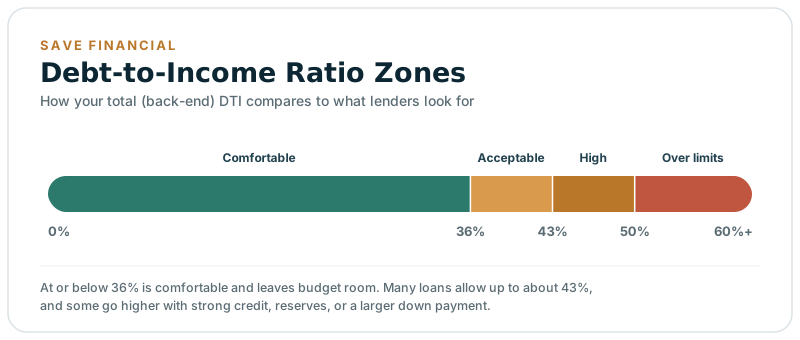
Your debt-to-income ratio, or DTI, compares your monthly debt payments, including the new mortgage, to your gross monthly income, and it's one of the most important qualification factors. Most programs want your total DTI under roughly 43 to 50 percent, with some allowing higher given strong credit, reserves, or a large down payment. A lower ratio means an easier approval and more room in your budget. You can estimate yours with our DTI calculator. If your ratio is tight, paying down a debt with a monthly payment, especially a car loan or credit card, can move it enough to matter.
How much you put down affects both your qualification and your loan size. Down payment requirements vary by loan: VA loans allow zero down for eligible veterans, FHA asks for 3.5 percent, and conventional loans can go as low as 3 percent for some buyers, up to 20 percent to avoid mortgage insurance. Your down payment can come from savings, a family gift on a primary residence, or a down payment assistance program, which our down payment assistance guide covers. In California's higher-priced markets, the down payment is often the biggest hurdle, which is exactly why low-down programs and assistance matter so much here.
Lenders verify that you have the funds to close, your down payment plus closing costs, and many programs also want cash reserves left over afterward. Reserves are typically measured in months of the new housing payment, and requirements range from none on some loans to several months on others, more for investment properties or jumbo loans. Lenders review your bank and asset statements and want to source any large deposits, so avoid unexplained cash moving into your accounts before you apply. Having your assets documented and stable makes this part of qualification smooth.
Beyond the income amount, lenders care about stability. A consistent two-year employment or self-employment history reassures them your income will continue. Job changes aren't necessarily a problem, especially within the same field or for a promotion, but a recent gap or a switch to a new line of work can raise questions that need explaining. If you're changing jobs around the time you're buying, tell us early, because how and when you change can affect your approval. Steady, documented income is what lenders are really after.
Qualification isn't only about you; the property has to qualify too. The lender orders an appraisal to confirm the home is worth at least the purchase price and, for some loans like FHA and VA, that it meets minimum condition standards. The property type matters as well, since condos may need project approval and unusual properties can face tighter guidelines. A home in poor condition or one that appraises low can complicate the loan, which is why the appraisal is part of the process. We flag property concerns early so they don't surprise you late.
Qualifying to refinance works much like qualifying to buy, with one addition: your home equity. Lenders still review your credit, income, debt-to-income ratio, and assets, and the property still has to appraise. The difference is that a refinance is limited by how much equity you have, expressed as loan-to-value, and cash-out refinances leave more equity in the home than rate-and-term refinances. Self-employed homeowners refinance using the same alternative income programs available to buyers, so understated tax returns don't have to block a beneficial refinance. If you already own a home and are wondering whether you'd qualify to refinance, the same factors apply, plus your equity, and we can check quickly.
California's high prices raise the income bar, since a larger loan requires more income to support the payment within DTI limits. That's the challenge. The counterbalance is the range of programs available: government loans with low down payments, assistance programs, high loan limits in coastal counties, and alternative income programs for the self-employed. A buyer who doesn't qualify one way often qualifies another, which is the real value of comparing programs. The question usually isn't whether you can qualify, but which program fits your profile best.
One honest point that often gets lost: the amount you qualify for is a maximum, not a target. Lenders approve you based on ratios and guidelines, but those don't account for your goals, your lifestyle, or the expenses that don't show up on a credit report. Just because you can qualify for a large payment doesn't mean it's the payment you'll be happy with, especially in high-cost California where the maximum can be a stretch. A good advisor helps you find a comfortable number, not just the biggest one a lender will allow. We'll show you your maximum, but we'll also help you land on a payment that leaves room for the rest of your life, because qualifying for a home you can't enjoy isn't a win.
If your own file falls short, adding a co-borrower can sometimes bridge the gap. A co-borrower, often a spouse, partner, or family member, adds their income to yours and shares responsibility for the loan, which can lower your combined debt-to-income ratio and strengthen the application. Their credit and debts factor in too, so a co-borrower helps most when they bring strong income and clean credit. Some loan programs also allow a non-occupant co-borrower, someone who won't live in the home but helps you qualify, though the rules vary by program. Adding a co-borrower is a real tool, and we'll help you weigh whether it strengthens your file and how it affects the loan for everyone on it.
You can improve your odds with a little preparation. Check your credit and correct errors, and pay down balances to lift your score and lower your DTI. Keep your income documented and avoid job changes right before applying if you can. Save toward your down payment, closing costs, and a reserve cushion. Avoid opening new credit or making large purchases, since new debt raises your DTI and recent inquiries concern lenders. Keep your accounts stable and be ready to explain any large deposits. And get pre-approved early, so you know exactly where you stand and can fix any issue before you're under contract. Small moves in the right areas can change your approval or your rate.
Knowing the pitfalls helps you avoid them. The most common reasons for a denial are a debt-to-income ratio that's too high, a credit score below the program's minimum or recent credit problems, insufficient documented income, not enough funds to close or meet reserve requirements, an unstable employment history, and property or appraisal issues. Many of these are fixable with preparation or by choosing a different program, which is why an early conversation matters. A denial from one lender or program doesn't mean you can't qualify elsewhere, and finding the right fit is exactly what we do.
The best way to find out how you qualify is to get pre-approved. We review your credit, income, debt, and assets, tell you what you can borrow, and identify anything worth improving before you shop. A real pre-approval turns qualification from a guessing game into a clear number, and it makes your offer stronger when you find a home. See our pre-approval page for how it works.
What do you need to qualify for a mortgage in California? Lenders look at your credit, income, debt-to-income ratio, down payment, and assets, plus your employment stability and the property. Strength in one area can offset weakness in another, and different programs fit different profiles.
What credit score do you need to buy a house in California? It depends on the loan. Conventional generally starts around 620, FHA can go to 580 for the low down payment, and VA has no set minimum though lenders often look for the high 500s to low 600s.
What debt-to-income ratio do you need? Most programs want your total DTI under roughly 43 to 50 percent, with some allowing higher given strong credit, reserves, or a larger down payment. A lower ratio makes qualifying easier.
How much income do I need to qualify? Enough that the payment, plus your other debts, fits within the program's DTI limit. Because California prices are high, the income bar can be significant, though low-down programs and the right loan structure help.
Can I qualify if I'm self-employed? Yes. Traditional loans use your tax returns, and alternative programs like bank statement and 1099 loans qualify on your real cash flow when write-offs understate your income.
How much down payment do I need to qualify? It varies by loan: zero for eligible VA borrowers, 3.5 percent for FHA, and as low as 3 percent for some conventional loans. Gift funds and assistance programs can help.
Do I need cash reserves to qualify? Some loans require reserves, measured in months of the housing payment, while others don't. Investment properties and jumbo loans typically require more.
Why do mortgage applications get denied? Common reasons include a high DTI, low credit or recent credit issues, insufficient documented income, not enough funds to close, an unstable job history, or property and appraisal problems. Many are fixable or solved with a different program.
Qualifying is easier when someone knows which program fits your profile, and that's what a broker does. We review your full picture, credit, income, debt, down payment, and assets, and match you to the loan most likely to approve you and price you well. If one area is weak, we know which programs are flexible there, and we'll tell you honestly what to strengthen first. Our pre-approval page is the place to start.
You're welcome to verify our license on NMLS Consumer Access (NMLS #377740, DRE #01875766).
Newport Beach (headquarters) Save Financial, 4000 MacArthur Blvd, Suite 600, Newport Beach, CA 92660, (949) 379-5320
Marina del Rey Save Financial, 13763 Fiji Way, Suite EU2, Marina del Rey, CA 90292, (310) 759-4757
The fastest way to know is to get pre-approved. Tell us about your credit, income, and savings, and we'll show you what you qualify for and how to make it stronger.
If you're buying or refinancing anywhere in California, contact Save Financial. Call our Newport Beach office at (949) 379-5320 or request your free pre-approval to get started.
This page is general educational information about mortgage qualification, not a commitment to lend. Approval, loan programs, rates, and terms depend on borrower qualifications, lender guidelines, and property, and are subject to change. Save Financial is a California-licensed mortgage brokerage (NMLS #377740, DRE #01875766). Equal Housing Opportunity.
Save Financial is a California-licensed mortgage brokerage (NMLS #377740, DRE #01875766) with offices in Newport Beach and Marina del Rey. Call (888) 703-1840 or request your free rate quote. Rates and terms are subject to change and depend on borrower qualifications and lender approval. Equal Housing Opportunity.